
Why this matters right now (and why July is a sensible time to act)
For many catering operators, the easiest time to book planned maintenance is the brief lull between major trading pushes. In parts of East Anglia, that window often lines up with the end of the school year and the start of the summer holidays—when some workplace and education catering demand shifts, and rota flexibility can improve.
For example, Suffolk’s published school term dates show the summer term ending on Monday 20 July 2026. That makes the period from late July into August a practical moment to tidy paperwork, confirm safety systems are working as intended, and schedule any engineer-led testing that you’ve been pushing back during peak service. (suffolk.gov.uk)
paragraphsContinuedNote: This post is deliberately not about DIY fixes. Gas appliances, pipework, flues and safety devices must be maintained in a safe condition, and any gas work should be carried out by a suitably qualified Gas Safe registered engineer. The aim here is to help you prepare your site, your people and your records so engineer visits are efficient and you stay operationally resilient. (hse.gov.uk)
The non-negotiables: what HSE expects in commercial catering
HSE’s catering and hospitality guidance makes it clear that commercial kitchens need safe installation and safe ongoing use/maintenance of gas-fired catering equipment. In practice, that comes down to three linked areas: (1) the condition of gas appliances/pipework/flues and safety devices, (2) adequate ventilation and effective extraction, and (3) safety systems such as interlocks working correctly. (hse.gov.uk)
For commercial sites using mechanical ventilation with gas cooking equipment, HSE also highlights that the gas supply should be interlocked with ventilation for the appliance—so the system prevents unsafe operation if ventilation isn’t proven. The interlock is not a ‘nice-to-have’; it’s central to safe kitchen operation. (hse.gov.uk)
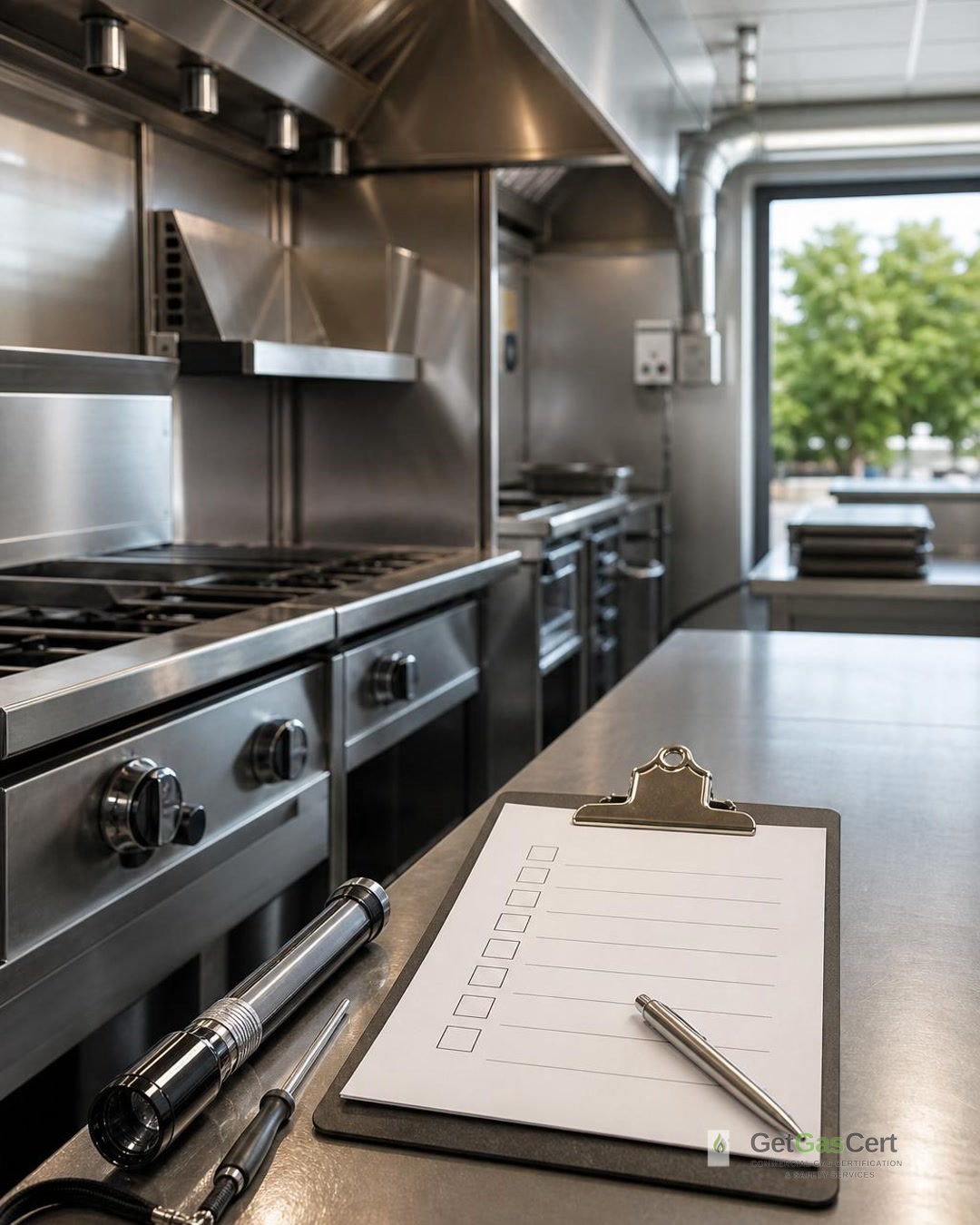
A practical end-of-term checklist (operator actions only)
Use this checklist to get ready for an engineer visit and reduce the risk of last-minute failures, downtime, or missing documentation. None of these steps involve altering gas equipment—think of them as “make it easy to verify” actions.
-
Collect and organise your gas safety file (30 minutes) - Latest gas safety record(s) for the premises and any catering-specific certificates/records you hold. - Asset list: each appliance, fuel type (natural gas/LPG), location, and serial/ID. - Any recent reports, remedial recommendations, and proof of completed follow-up work. - Your ventilation/extraction service records (and any canopy/duct cleaning evidence you maintain).
-
Confirm who your duty holder is (10 minutes) - Write down who is responsible on-site for authorising shutdowns, reporting defects, and arranging engineer attendance. - Ensure that duty holder (or deputy) is available on the day—engineer time is often lost waiting for access, isolation permissions, or sign-off on safe re-energisation.
-
Walk the kitchen for “obvious blockers” (20 minutes) - Check that fixed ventilation air inlets are not obstructed by stock, cling film, temporary boards, or seasonal display items. - Check that extraction canopy and filters are in place and correctly seated (don’t modify them—just ensure nothing is missing or obviously displaced). - Make sure appliance routes and isolation points are accessible (engineers need safe access; do not dismantle appliances yourself).
-
Interlock readiness check (operator-level) (15 minutes) - Identify what proves airflow on your system (for many kitchens this is an airflow/pressure device integrated with the interlock). - Confirm staff understand what the interlock does: it’s there to prevent gas operation without adequate mechanical ventilation. - If the interlock shows faults, nuisance trips, or confusing indicators, log the symptoms and times (avoid guessing causes). Arrange a Gas Safe registered engineer and, where relevant, a competent ventilation contractor to investigate—do not tamper with, alter or interfere with the interlock system. (hse.gov.uk)
The July 2026 operational angle: ventilation strain without weather hype
It’s normal for kitchens to feel more challenging in summer. Even without declaring any specific “event weather”, the Met Office’s East of England forecast updates around mid-July 2026 indicate warm conditions are possible, and late July can bring a higher chance of showers or thunderstorms than earlier in the month. That kind of pattern tends to increase the importance of keeping ventilation systems working consistently (comfort, performance and safety), and it can expose weaknesses such as partially blocked filters, poorly understood interlock routines, or doors being propped open in ways that disrupt airflow patterns. (weather.metoffice.gov.uk)
The key point: warm spells don’t change your legal duties, but they can make existing ventilation and interlock issues show up more often—exactly when you least want downtime. Treat July as a sensible prompt to confirm your “safe to operate” building blocks are reliable. (hse.gov.uk)
Common “interlock misunderstandings” that cause failed checks or service disruption
These are recurring issues in catering sites and mobile operations. Addressing them is mostly about training, access and housekeeping (not engineering):
Mistake 1: Treating interlock trips as an ‘electrical nuisance’ If the interlock is preventing gas operation, assume it’s protecting you from operating without proven ventilation. Repeated resets, workarounds or improvised routines are a red flag. Your SOP should be: stop, make safe, report, and arrange competent attendance. HSE’s employer guidance explicitly connects safe operation to ventilation and interlocking. (hse.gov.uk)
Mistake 2: Not realising “ventilation” includes make-up air Staff often focus on the canopy fan only. But overall ventilation depends on air coming in as well as air being extracted. Blocked grilles, closed louvres, or stored items in front of air inlets can contribute to poor performance and unexpected interlock behaviour. Keep inlet routes clear and included in opening/closing checks. (hse.gov.uk)
Mistake 3: Records scattered across email, apps and folders When documentation isn’t centralised, sites lose time proving compliance during audits, landlord/agent queries (where relevant), or insurance requests. A single “gas safety file” (digital or physical) with a simple index is usually enough to avoid panic searches during service.
Mistake 4: Confusing “routine cleaning” with “maintenance” Cleaning filters and canopies is important, but it’s not a substitute for engineer checks of gas safety devices, flues, and safety systems. HSE’s catering FAQs emphasise the duty to keep appliances, flues, pipework and safety devices maintained in a safe condition. (hse.gov.uk)
A simple end-of-term SOP you can implement this week
If you want one practical change that helps immediately, implement an “end-of-shift safety notes” routine for two weeks (14 days) from today, Saturday 18 July 2026. It creates a short evidence trail that helps engineers diagnose intermittent problems and helps managers spot patterns before they become downtime.
What to record (1 minute per shift) - Any interlock alarms/fault lights (what you saw, time, what equipment was in use). - Any extraction issues noticed by staff (unusual noise, poor capture, excessive heat/smoke escaping). - Any changes to operating conditions (e.g., door propped open due to deliveries; heavy service period). - Any “stop and report” events (equipment shut down and isolated pending engineer visit).
What not to record - Don’t write “fixed by…” unless a suitably qualified Gas Safe registered engineer (and where relevant, a competent ventilation specialist) has attended and confirmed what was done. Avoid informal ‘we tweaked it’ notes—those can create liability questions later.
After 14 days - Review for repeated patterns. - If problems recur, schedule a planned engineer visit rather than waiting for a breakdown. HSE’s guidance for employers is clear that safe condition, adequate ventilation and interlocking are core controls, not optional extras. (hse.gov.uk)
East Anglia note: planning around seasonal staffing and access (Cambridgeshire focus)
Operators around Cambridgeshire often tell us the practical problem isn’t “knowing” what needs doing—it’s finding a window when: - a manager can be on-site to grant access, - the kitchen can tolerate a short shutdown, and - you can get the right contractor(s) lined up.
If your August rota is already under pressure, it’s worth using the week beginning Monday 20 July 2026 (when many schools in the region begin wrapping up term) to book inspections/testing for quieter mornings, planned closing days, or split-shift windows. This is operational planning, not a claim about any one business’s calendar—and it can reduce disruption. (suffolk.gov.uk)
When to stop and call a professional immediately
If you suspect a gas safety issue, don’t try to diagnose or correct it in-house. Arrange attendance by a suitably qualified Gas Safe registered engineer.
Examples of “stop and report” triggers include: - repeated interlock trips that prevent normal safe operation, - signs of poor combustion or poor ventilation performance affecting safety, - concerns about flueing/ventilation integrity, - staff symptoms that could be consistent with carbon monoxide exposure (HSE notes early symptoms can mimic flu/tiredness, which is one reason CO risk must be taken seriously). (hse.gov.uk)
This is also a reminder that gas safety in commercial settings sits within employers’ broader health and safety duties, and HSE provides specific catering and hospitality guidance to support that. (hse.gov.uk)