
Why this matters right now (Saturday 18 July 2026)
Mid-July is when mobile catering operators typically feel the squeeze: longer trading weeks, more weekend events, and more last‑minute pitch changes. If you work on holiday parks, coastal pitches or festivals, you’ll often be asked to produce paperwork quickly (sometimes at the gate) and to demonstrate that your gas system is being maintained properly.
For East Anglia, today’s Met Office forecast for the East of England (updated 11:00 on Saturday 18 July 2026) shows temperatures close to average with cloud and a chance of isolated coastal showers. That’s not a “weather story” in itself—but it is a reminder that summer trading still brings variable conditions. Mobile units are routinely moved, re-levelled and connected/disconnected, which increases the value of a consistent, repeatable set-up routine and a simple documentation pack. (weather.metoffice.gov.uk)
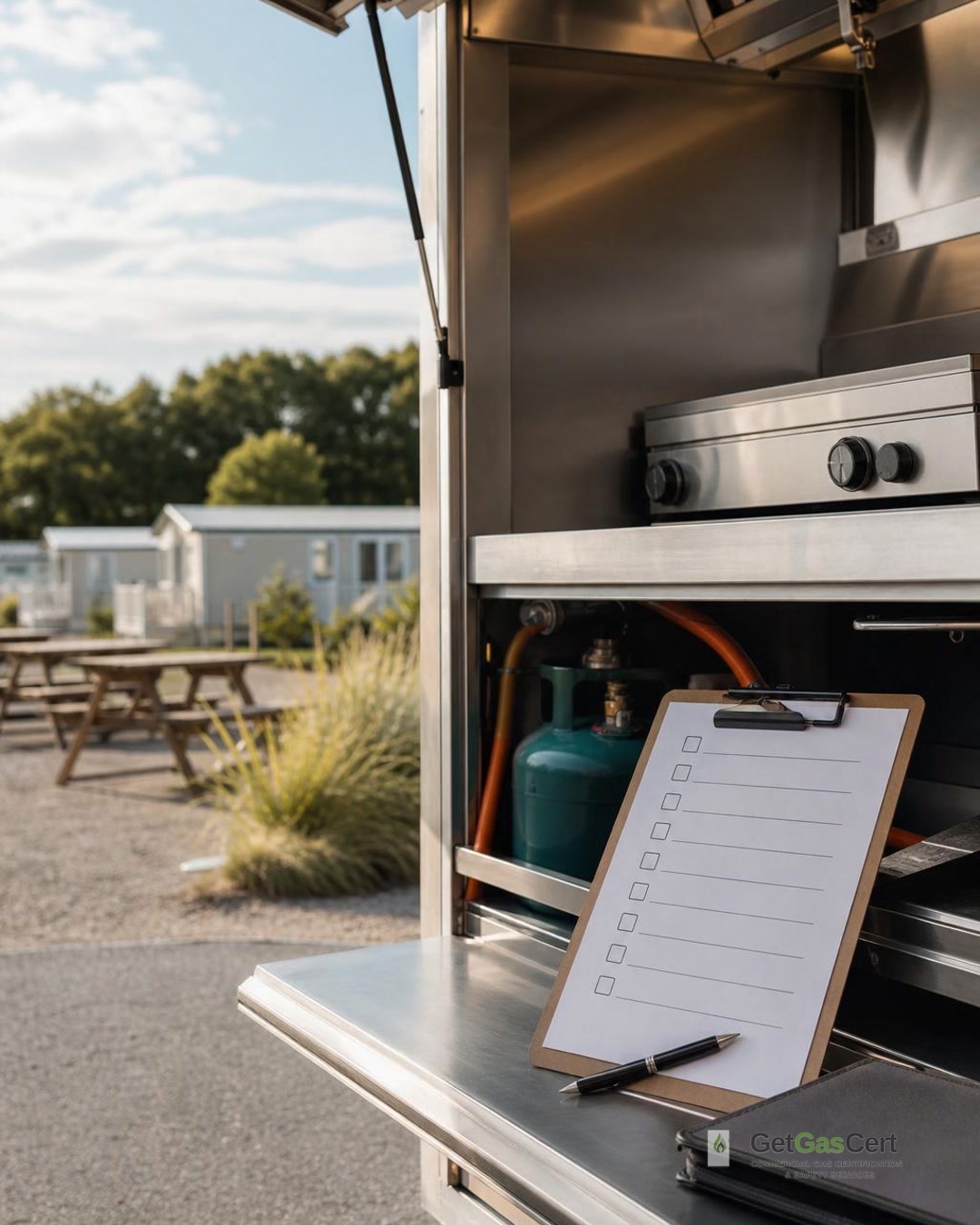
This article is a practical “what to keep in the van” guide. It avoids DIY gas work and focuses on preparation, daily checks that don’t involve altering gas equipment, and how to stay ready for site manager requests or inspections.
The baseline duty: gas equipment must be kept safe (and only competent engineers should do gas work)
For commercial kitchens and catering operations, the Health and Safety Executive (HSE) is clear that businesses must ensure gas appliances, flues, pipework and safety devices are maintained in a safe condition. That obligation underpins why documentation and planned maintenance matter—especially when you’re busy and working across multiple locations. (hse.gov.uk)
In mobile catering, there’s an additional practical challenge: equipment is subject to vibration, frequent cylinder changes and repeated set-ups. None of that changes legal duties—but it does make “good routine” and “good records” more important than in a fixed kitchen.
If you suspect a gas issue (smell of gas, sooting, unstable flames, repeated burner failure, unexplained headaches/drowsiness in staff, interlock nuisance trips, or damage to pipework/hoses), stop using the appliance and arrange a suitably qualified Gas Safe registered engineer. Staff must not make changes to gas equipment and must never tamper with, alter or interfere with any interlock system or safety device.
Your mobile catering LPG ‘documentation pack’: what to keep ready
Think of this as the set of items you can produce quickly if a site manager, event organiser, insurer, or enforcement officer asks, “What’s your gas set-up and how do you know it’s safe?” Keep both a paper copy (in a folder) and a digital copy (phone/tablet) where possible.
-
Your current gas safety documentation for the unit/appliances. Mobile catering operators are commonly asked for evidence of recent inspection/testing by a Gas Safe registered engineer who is qualified for the type of work and appliances involved. Keep the most recent certificates/records together, and ensure the appliance list matches what’s actually installed/connected on the unit.
-
A simple appliance & fuel inventory (one page). Include: make/model, fuel type (LPG/propane/butane where relevant), location in the unit, and serial numbers. This avoids confusion when you swap an appliance mid-season.
-
Site/emergency contacts. A card with: who to call on the event/park if you need to isolate the pitch supply (where relevant), and your engineer contact process. In busy trading periods this saves minutes when you need them most.
-
Manufacturer instructions (or quick-reference pages). Keep the key pages that cover safe use and cleaning precautions (not repair). HSE guidance emphasises following manufacturer’s instructions for maintenance planning in premises under your control. (gov.uk)
Your ‘set-up and shut-down’ routine (non-technical, staff-friendly)
A good routine is one that a new starter can follow on day one, without improvising. Write it down and train it. Here’s a practical structure you can adapt to your unit.
Before service (arrival / pitch set-up):
• Positioning & ventilation: ensure nothing blocks fixed vents and that air can flow as designed. Don’t store packaging, cloths or spare stock in a way that reduces ventilation routes.
• Visual condition check (no tools): look for obvious damage to accessible pipework guards, appliance casings, and the cylinder locker area. If anything looks damaged, stop and escalate to a Gas Safe registered engineer.
• Housekeeping: keep combustibles away from hot surfaces and burners. This is basic but often the first thing that drifts under pressure in peak season. HSE’s catering gas safety guidance stresses safe use and maintenance of gas-fired catering equipment. (hse.gov.uk)
During service: keep it boring (in a good way)
In mobile catering, the safest operating pattern is the most consistent one. Aim to avoid “quick tweaks” between tickets.
• Don’t ‘chase performance’ by changing anything on gas equipment. If an appliance isn’t performing normally, take it out of use and get it checked by a suitably qualified Gas Safe registered engineer.
• Keep extraction/ventilation on as intended. For fixed commercial kitchens, interlocks are part of the wider approach linking ventilation and gas supply safety; for new commercial catering establishments, IGEM publishes requirements for interlock design/application (note that IGEM/UP/19 scope excludes mobile catering). Even where the formal standard scope differs, the operational principle remains: ventilation and gas safety controls are there for a reason—don’t interfere with them. (igem.org.uk)
• Watch for early warning signs that justify stopping and escalating: persistent yellow flames, heavy sooting, repeated flame failure, or staff feeling unwell. Don’t attempt diagnosis.
After service: close-down checks that prevent next-day surprises
Close-down is where fatigue causes misses. Keep it short and repeatable.
• Clean safely: allow equipment to cool and follow manufacturer guidance for cleaning. Avoid getting water/chemicals into burners or controls.
• Quick “leave it safe” walk-through: confirm appliances are off, the area is tidy, and there’s no smell of gas. If you ever detect gas odour, stop and escalate—do not try to locate leaks yourself.
• Record anything unusual: a one-line note (“left-hand hob slow to light”, “interlock tripped twice”, “smell noted near cylinder locker—stopped service”) helps your engineer fix root causes quickly and demonstrates responsible management.
The summer trading trigger: staffing churn and ‘documentation drift’
The recurring mid-season problem isn’t usually missing certificates—it’s that the paperwork no longer matches the unit after a few hectic weeks.
Common drift points to check this weekend:
• Appliance swaps: did you temporarily add a fryer, swap a griddle, or remove an oven? Update your one-page inventory and make sure your next engineer visit covers what’s actually in use.
• Cylinder arrangements: are spare cylinders being stored where they shouldn’t be, or blocking access/ventilation? Tidy this now before a busy Saturday night.
• New starters: can every staff member explain (in plain terms) what to do if they suspect a gas problem? HSE’s sector guidance is aimed at catering operators and supports the idea that staff need clear instruction in safe use. (hse.gov.uk)
Planning inspections and maintenance in the school summer window (Cambridgeshire example)
For some operators, summer can be the busiest season; for others (especially those serving education or operating near campuses), it’s a rare chance to book maintenance without disrupting service.
Cambridgeshire County Council’s Holiday Activities and Food (HAF) programme states its Summer 2026 programme runs from 21 July to 28 August 2026. If you support community feeding, school holiday provision, or nearby sites that see changed footfall during this period, it’s worth locking in your gas safety and ventilation-related appointments early so you’re not trying to find an engineer at the same time as everyone else. (cambridgeshire.gov.uk)
Even if your own busiest weeks are during the holidays, you can still use this timing to plan: pre-book an inspection date, prepare access to appliances, and allocate a quiet hour for your team to reset the documentation pack.