
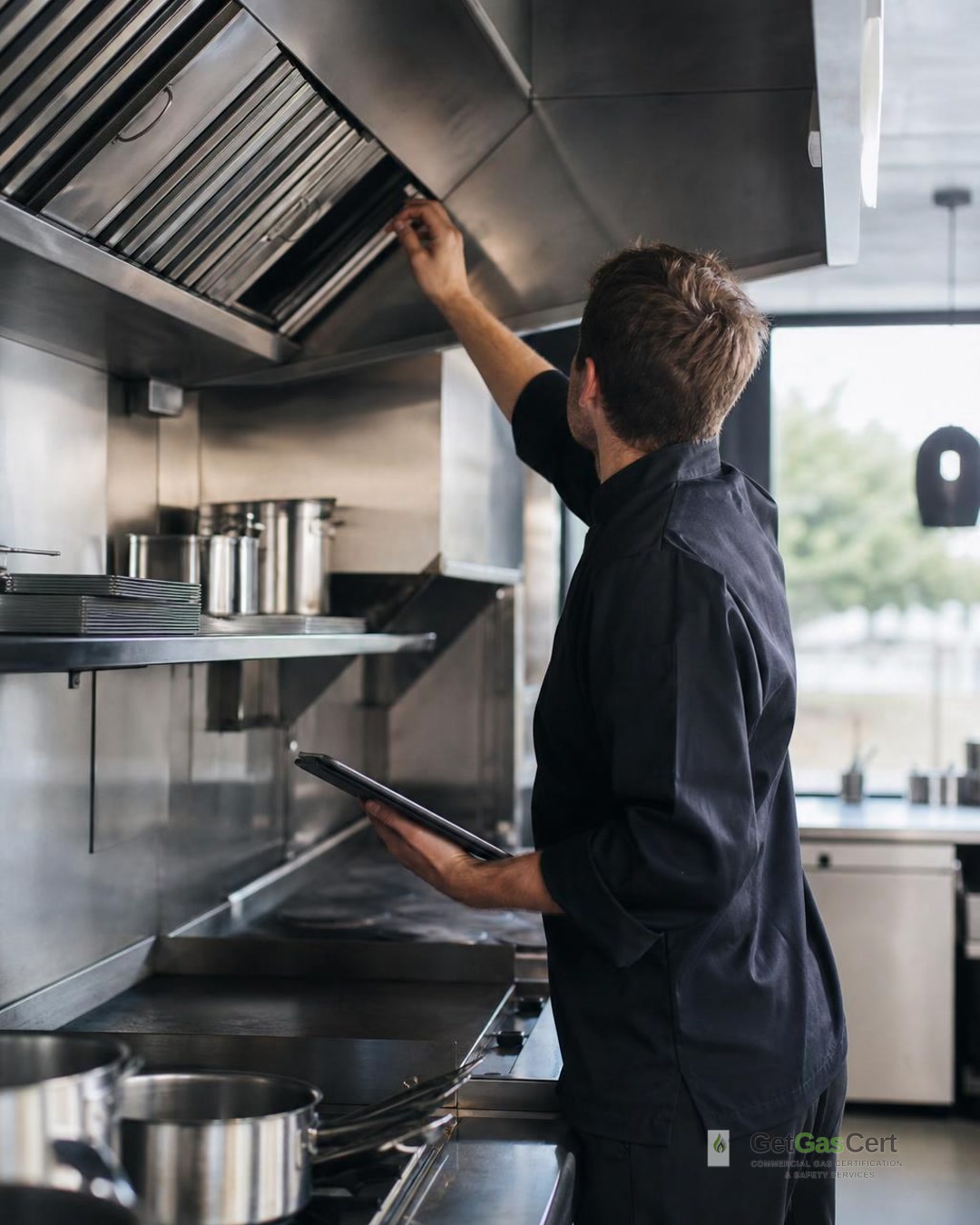
Why this matters right now (and why it’s not just “summer discomfort”)
Saturday 18 July 2026 lands in the middle of peak summer trading for hospitality, with staffing changes, long services and higher kitchen heat loads. The Met Office forecast for the East of England updated today indicates cooler conditions compared with recent nights but still “remaining warm” into next week. That swing—hot spells followed by cooler, breezier periods—often changes how kitchens behave (door propping, fan use, louvre positions, extract performance), and those operational habits can make or break safe air movement during service. (weather.metoffice.gov.uk)
HSE’s catering ventilation guidance is clear that kitchen ventilation isn’t only about comfort: it affects combustion, removal of combustion products and the risk of carbon monoxide build-up if make-up air is inadequate. Where extraction serves the purpose of a flue for certain appliances, an appropriate interlock linking airflow to gas supply is required, and any work on gas appliances must be carried out by a Gas Safe engineer. (hse.gov.uk)
Separately, England has seen heat-health alerts during July 2026, which is a useful reminder that hot working environments are a real operational risk to staff wellbeing and performance. The point for caterers isn’t to treat a heat alert as a gas-compliance trigger (it isn’t), but to use the season to tighten everyday ventilation discipline—because busy, hot services are when “small” ventilation and interlock issues are most likely to surface. (gov.uk)
The no-DIY principle (what staff must and must not do)
This article is about preparation, awareness and routine operational checks only. Staff should never attempt gas work, adjustments, testing or repairs. If something doesn’t look or feel right, stop using the appliance and arrange a suitably qualified Gas Safe registered engineer.
In particular, staff must never tamper with, alter or interfere with any interlock system, safety control, air-proving device or gas shut-off arrangement. If the system isn’t behaving as expected, treat it as a fault to be investigated by competent engineers.
The safe takeaway from HSE guidance is simple: keep ventilation effective, don’t block air inlets or obstruct flues, and ensure gas appliances are maintained and checked by competent people. (hse.gov.uk)
A practical ‘keep-ready’ routine you can run weekly in July (15 minutes, manager-led)
Use this as a repeatable routine for sites across East Anglia—particularly kitchens around Norfolk and Suffolk coastal trading where doors, wind and salt air can affect vents and fan performance over time. Keep it consistent and log it (see the log template section).
-
Walk the make-up air route (outside → kitchen). Identify where replacement air is meant to come from (grilles, louvres, dedicated supply fans, transfer air paths). Confirm those routes are not blocked by deliveries, stored items, flyscreens clogged with grease/dust, or temporary signage.
-
Walk the extract route (canopy → duct → discharge). You are not inspecting internally—just confirming obvious external obstructions: discharge points aren’t blocked, bird guards aren’t clogged, and access panels aren’t missing or loose.
-
Confirm the kitchen’s “normal service posture”. Decide (and brief) what “normal” looks like during service: which doors may be opened, which must remain closed, and what not to do (for example, don’t wedge fire doors open as a ventilation method; use the designed supply/extract routes). Keep this as a simple one-page note for supervisors.
-
Interlock behaviour check (observational only). At a quiet time, observe that the system behaves normally at start-up and during fan operation—without any attempts to change settings or simulate failures. If staff report nuisance trips or ‘it only works if…’, record the symptom and escalate to a competent engineer to diagnose. HSE notes that where extraction serves as a flue for some appliances, an appropriate interlock is required. (hse.gov.uk)
Front-of-house and management: the three summer decisions that quietly affect gas safety
In many venues, the ventilation system is fine—until trading decisions push it outside its intended operation. Three common July patterns are worth managing explicitly:
Decision 1: “We’ll run fewer fans to cut noise.” Reducing extraction or supply may change air movement and make-up air balance. If your kitchen has interlocked systems, changes may also affect whether equipment can operate. The safe approach is: don’t change ventilation strategy ad hoc; if noise or comfort is an issue, schedule a competent review rather than improvising.
Decision 2: “Keep doors open for a breeze.” Door propping can disrupt designed air paths and pressure balance, and can also create operational problems (pests, fire safety). Set clear door rules for service periods, and make the designed ventilation do the work.
Decision 3: “We’ll add portable cooling.” Any additional fans or portable AC can change airflow patterns. You don’t need to ban them automatically, but you should risk-assess their placement so they don’t blow across burners, pull fumes away from capture, or encourage staff to block supply air grilles. If you need a change, get competent advice and keep the outcome documented. HSE’s ventilation guidance emphasises the importance of adequate make-up air to avoid accumulation of combustion products. (hse.gov.uk)
Signs your ventilation or make-up air is slipping (what to look for during service)
These aren’t “diagnostics”—they’re practical cues to start a conversation and arrange competent support before a failure disrupts service:
• Canopy capture seems worse than usual (fumes escaping into the kitchen even with ‘normal’ cooking).
• Staff report headaches, unusual fatigue, or the kitchen feels “stuffy” more quickly than before. HSE notes inadequate ventilation can contribute to heat stress and unsafe systems of work. (hse.gov.uk)
• Doors become hard to open/close during peak extract (pressure imbalance), or you notice paper towels pulled strongly towards/away from door gaps (an informal indicator of strong air movement changes—no testing implied).
• Complaints increase after layout changes (a new appliance line-up, a new pass, or additional equipment placed under/near the canopy).
A simple paperwork pack that keeps you ‘audit-ready’ without doing engineering
If an engineer visit is coming up—or you just want to reduce downtime—organise the following in one folder (digital or paper). This is especially helpful for multi-site operators across Cambridgeshire where managers rotate and “tribal knowledge” gets lost.
-
Your current gas safety documentation (whatever your organisation holds for commercial gas certification) and any recent remedial recommendations, so you can show what was done and what remains outstanding.
-
The ventilation/interlock quick log (see below). Engineers and auditors value clear records of symptoms, dates and who observed them—without staff attempting fixes.
-
A current equipment list (appliances under the canopy and any gas appliances elsewhere). Include make/model where known, and note any recent changes in layout or equipment type.
-
Maintenance contacts and escalation rules: who can authorise service interruptions, who calls the engineer, and what to do if an appliance is suspected unsafe (stop using it; escalate). HSE’s employer guidance stresses not using appliances you know or suspect are unsafe. (hse.gov.uk)
Log template: the ‘15-minute weekly’ record (copy/paste)
Keep this simple and consistent. Avoid technical language and don’t write “tests” you didn’t do.
Date / site / manager:
Weather/conditions note (optional, factual only): e.g., “Warm service weekend” (don’t add forecasts).
Make-up air route clear? (Yes/No) Notes:
Any grilles/louvres obstructed? (Yes/No) Notes: (what/where) — remove non-fixed obstructions only; otherwise escalate via maintenance process, not DIY alterations to the system or gas equipment. (hse.gov.uk) Extract discharge visibly clear externally? (Yes/No) Notes: (what/where) Interlock/system behaviour observed as normal in routine use? (Yes/No/Not observed) Notes: (describe symptom only) Door rule briefed to shift lead? (Yes/No) Actions raised: (job number / who notified / target date)
Planning ahead: late-summer trading and why to book checks early
Even though today is 18 July 2026, it’s sensible to plan now for late summer and early autumn trading: staff holidays, back-to-school patterns and the late August bank holiday period can compress maintenance availability. In England and Wales, the Summer bank holiday in 2026 falls on Monday 31 August 2026. (gov.uk)
Use the rest of July to schedule any essential professional attention to ventilation performance, interlock behaviour, or recurring nuisance shutdowns—so you’re not troubleshooting in the week of a high-demand weekend.
If you operate multiple kitchens, treat this as a standard seasonal control: run the same weekly routine everywhere, and prioritise sites with the highest heat load (chargrills, solid-fuel equipment, heavy frying) or those with a history of staff propping doors open.